
20–40% of city space sits idleSpace, enterprise, and talent are all waiting on an answer
Cafes and coworking spaces have large blocks of idle time, enterprises pay high fixed costs to run an office, and remote and hybrid workers can't find a stable third space to use. This report breaks that supply-demand gap into four areas (housing, work, space, and community) and examines each one with official statistics and field observation.

Beyond home and the office, somewhere you can focus deeply on work and still connect with people naturally. Cities often hold plenty of spaces like this, just scattered, sitting idle, never properly discovered.
Key findings
Each of the four areas has one key number. Click through for the full data, sources, and our reading of it.
Affordable living space is limited, so few homes have room for a dedicated work desk
Housing chapter → 02 Work 22.8% Workers remote at least 1 day a month, 2024Hybrid work is now a regular arrangement, and employees want more focus space than offices provide
Work chapter → 03 Space 20–40% Idle time at cafes and coworking spaces, field observationThe seats already exist, with 4,824 cafes nationwide, but they aren't connected to each other
Space chapter → 04 Community ~70% Seat-only participants lost within 3 months, field observationA seat alone doesn't keep people coming back; connections with peers do
Community chapter →Few homes have room for a work desk
Taipei's house price-to-income ratio is 14.72x, and residents average about 10.5 ping (roughly 35 m²) of living space each. Under these conditions, "working from home" for remote workers often means the bedside, the dining table, or a shared room.
| Indicator | Figure | Source |
|---|---|---|
| National house price-to-income ratio | 9.47x | Ministry of the Interior Real Estate Information Platform, Q1 2026 Official statistics |
| Taipei house price-to-income ratio | 14.72x (same quarter; moving opposite to the national trend, down from the previous quarter) | Same as above Official statistics |
| Taipei households without owned housing | 347,339 households, 48.2% of them renting (about 167,000), for an estimated renter population of about 467,000 | Construction and Planning Agency / Taipei City Government Department of Budget, Accounting and Statistics, 2018–2022 Official statistics |
| Taipei living space per person | About 10.5 ping (roughly 35 m²) | Same as above Official statistics |
Housing ownership and living-space figures come from census-type data that is updated infrequently. As of September 2026, we found no version newer than 2018–2022.
The profiles below are composites drawn from situations that come up repeatedly in our interviews and on-site observation. Details are rewritten and combined, and no profile corresponds to a specific person.
Remote work is routine, but office layouts haven't caught up
42.7% of workers in Taiwan have worked remotely, and more than half of them now do it on a fixed monthly schedule. Enterprises pay over NT$3,000 per ping each month for office space, yet the focus space employees want most is in short supply there.
Offices lack the space employees want
Cathay Life's hub published a Future Workplace Survey in 2025 that asked employees at Taiwanese companies two questions: which spaces their office has now, and which they'd like it to have. The two largest gaps were both focus spaces. Quiet or focus zones went from 15% to 34%, more than doubling. Open-plan seating was the only item where desired levels fell below current ones.
Our reading: the office's strengths are collaboration and meetings, while its layout struggles to support long stretches of focused work. JLL's 2025 Asia Pacific workplace research likewise found that employees spend about half their time on work that requires concentration. That demand is what third spaces outside the office are positioned to absorb.
Read more
Per JLL's Q1 2026 Taipei office market report, average monthly Grade-A rent in the core business districts was NT$3,271 per ping, up 0.39% quarter over quarter, with full-year 2025 growth around 1.7%. Among submarkets, Dunbei runs about NT$2,891/ping, Songjiang-Nanjing and the western districts about NT$2,694/ping, and Nangang about NT$2,367/ping. This rent is owed regardless of actual seat utilization. The global figure comes from Cushman & Wakefield's Global Flexible Office Trends, where another 17% of enterprises plan to increase use; no equivalent Taiwan survey exists yet.
Flexible work benefits already offered in Taiwan
An existing budget channel: the Employee Welfare Fund
Taiwan's Employee Welfare Fund Act requires companies to set aside welfare funds in fixed proportions, managed by an employee welfare committee. Third-space spending can usually fall under the recreation or welfare-assistance categories, so companies don't need to create a new budget line.
See full contribution rates
| Contribution source | Rate | Basis |
|---|---|---|
| Total capital at founding | 1%–5% (one-time) | Employee Welfare Fund Act, Article 2 |
| Monthly operating revenue | 0.05%–0.15% | Same as above |
| Monthly employee salaries (payroll deduction) | 0.5% | Same as above |
| Proceeds from scrap and waste sales | 20%–40% | Same as above |
Spending caps also apply by category: up to 50% for recreation, 40% for education grants, and 30% for welfare assistance. Actual limits depend on each committee's own spending rules.
Read more
According to 104 Job Bank, over 5,300 postings in Taiwan mentioned WFH in January 2022, about 1.5% of all postings. It was a one-time survey with no public follow-up. US platform FlexJobs reported remote postings up 20% in Q1 2026 over the previous quarter, a US-market figure. Cumulative Gold Card permits reached 15,378, of which about 8,184 remain valid (Taiwan Employment Gold Card official site, December 31, 2025). Taiwan's digital nomad visa was relaxed in January 2026 to allow stays of up to 2 years; see /visa/.
The seats exist, they just aren't connected
Taiwan's cafe count grew by about 40% in six years, and Taipei has around 4.2 cafes per 10,000 residents. Each operates on its own with 20–40% of its hours idle. Users have to find them one by one, and space owners can't count on steady foot traffic.
| Indicator | Figure | Source |
|---|---|---|
| Cafes in Taiwan | 4,824, up 42.5% from 2018 | Ministry of Finance Statistical Bulletin No. 2, January 23, 2025 Official statistics |
| Cafe density in Taipei | About 4.2 per 10,000 residents | Same as above Official statistics |
| Spaces in the NexCircle database | 121 nomad-friendly spaces across 11 cities (most in Taipei 28 / Tokyo 23 / Seoul 22) | NexCircle's own data, see /spaces/ Own data |
Data still missing
Taiwan has no official count of coworking spaces nationwide and no seat utilization data for cafes or shared offices. For now, demand can be estimated, but the idle capacity available to absorb it cannot.
Read more
The Ministry of Finance publishes only cafe counts and revenue, not dwell time or share of work use. The 20–40% figure comes from our own field observation with a limited sample and needs broader validation through operator interviews and surveys.
Deskmag's 68% occupancy is a global coworking average and doesn't map one-to-one onto an idle-seat rate, so treat it only as an order-of-magnitude reference.
People stay for the people they know
Across several Taipei spaces we observed, nearly 70% of participants who only rented seats, with no community mechanism, dropped off within 3 months. Academic research also finds that peer connections do the most to reduce loneliness among remote workers.
The drop-off figure comes from interviews and observation since 2022 with a limited sample. It supports a research hypothesis; please note this when citing it.
Read more
A survey study of remote workers in Taiwan (N=195) found that horizontal peer relationships significantly reduce workplace loneliness (workplace friendship β=-0.49, p<.01), with a larger effect than vertical manager relationships. A separate study of digital nomad lifestyles documents one gathering format: hosts bring together nomads with shared interests for trips of 15 days or more, working independently by day and sharing dinner in the evening. That rhythm is close to the residency program's fixed weekly coworking day.
Where the field observation comes from
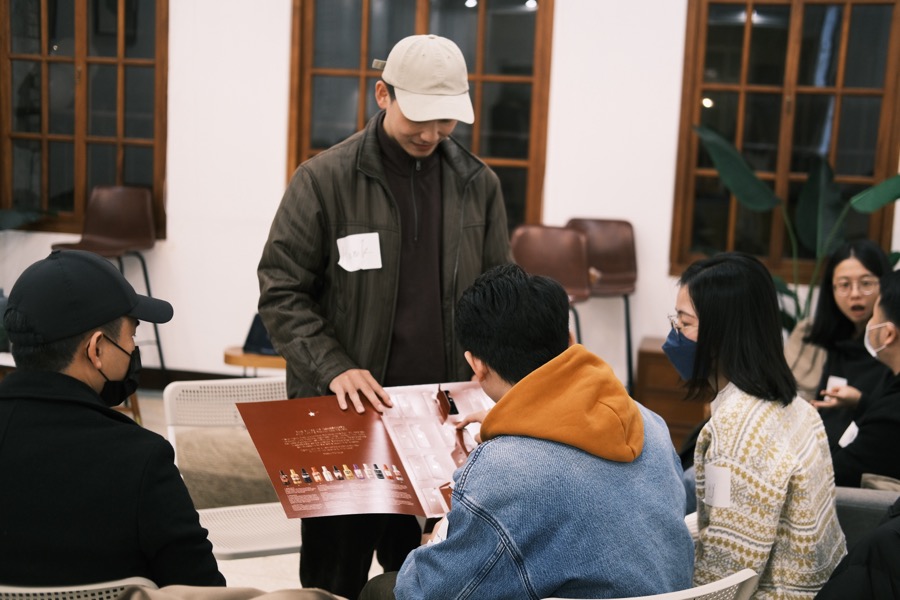
Ouer Guanghe community fieldwork
Long-running community events at cafes across Taipei, observing whether spaces stay lively when space and community are designed together.
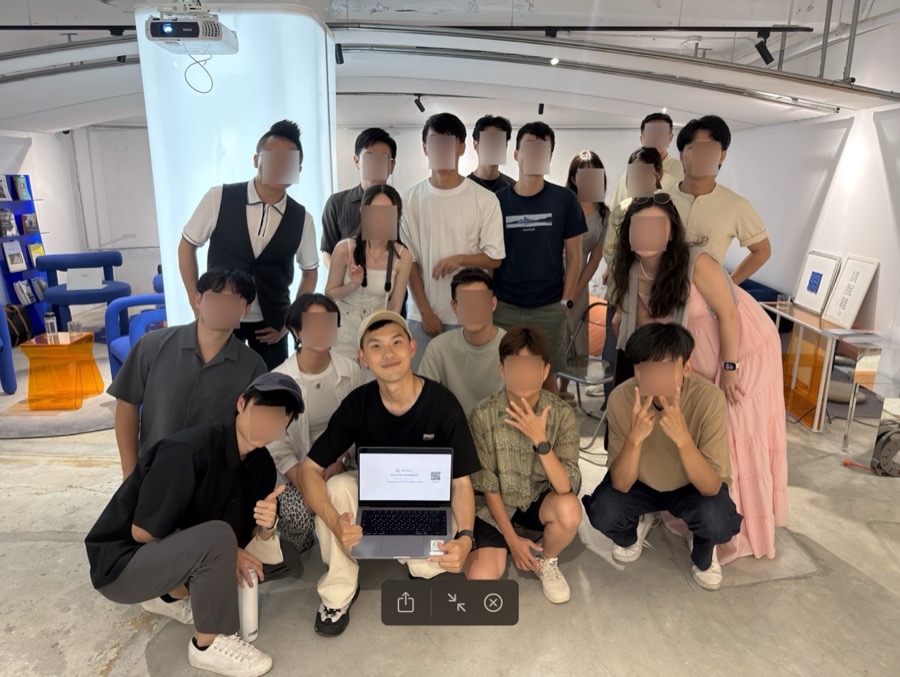
Old-house coworking residency
A residency at a coworking space converted from a former watch shop, observing how a community mechanism affects return visits.
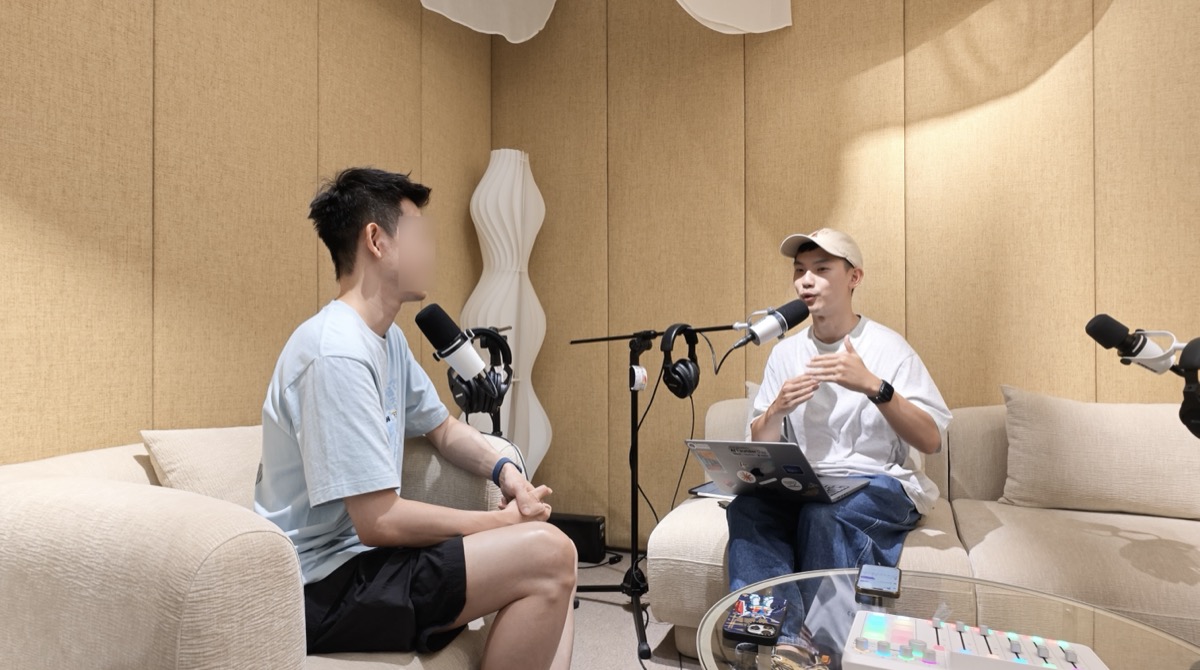
Coworking Day interviews
Regular conversations with remote workers, hybrid workers, and digital nomads newly arrived in Taipei, collecting needs that come up again and again.
The residency now has a growing group of long-term participants from fields including dream consultation, art therapy, and sound healing, and holds an in-person gathering every month.
What this means for spaces, enterprises, and talent
The numbers across all four chapters point to the same supply-demand gap. For each of the three groups involved, that gap means something different.
Space owners
- What we see
- 20–40% of hours sit idle, and first-time visitors don't always come back
- The opportunity
- Sell idle hours wholesale to people with steady demand, and use community events to raise return visits
Enterprises and HR
- What we see
- Office rent is fixed, the focus space employees want is scarce, and hybrid work is already the norm
- The opportunity
- Buy outside seat credits through welfare funds or travel budgets, replacing individual expense claims
Remote workers
- What we see
- Limited room at home, cafe spending scattered everywhere, and working alone can get lonely
- The opportunity
- One pass that works across many spaces, with regular work peers who keep showing up
NexCircle's approach: turning idle time into a subscription
NexCircle starts from idle urban space, researching and validating a third-space collaboration model for space owners, companies, and talent. Taipei is the first city for validation. Right now we're building a list of users through community events and the residency program. The next step is field-testing the subscription mechanism with a small group; enterprise procurement comes in only after the user-payment and revenue-share assumptions hold up.
The NexCircle Coworking Pass is a subscription service in design and not yet launched. It redistributes seats that already exist in the city but sit idle to the people who need them, through a single pass.
- Cafes and coworking spaces, with an idle-time share estimated at 20–40% (field observation)
- Space partners are joining on a rolling basis, expanding the network
- Remote workers, hybrid workers, and digital nomads
- In common: they need an outside space to work, without being tied to one place
Whether the model holds depends on a spread. For users, the monthly fee divided into per-visit cost has to come in below paying each space separately. For spaces, the wholesale rate has to beat the opportunity cost of leaving those hours empty.
Croissant (100+ cities, 700+ locations) and Deskpass (22 countries, 290 cities) already run subscription-based, cross-space access in mature markets. The closest local example in Taiwan is Sio-Tshiu, which builds its own venues, a different model from NexCircle's approach of pooling idle hours at existing independent spaces. NexCircle adds a community mechanism on top of this model, forming the cycle below.
- Spaces release idle hours: cafes and coworking spaces open up unused time slots
- Pass matches users: users are matched by need, and the clock starts at check-in
- Community mechanism: modeled on the residency program, with regular gatherings and mutual support
- Belonging drives return visits: once users build relationships, they come back and refer others
- Spaces gain steady traffic: brand visibility grows and more space owners join the network, back to step 1
Two hypotheses to test next
Can revenue sharing scale while working for both sides?
How the residency works today: the host pays no venue rent and brings time-limited programming to the space; the space owner fills idle hours without planning content. What we need to test is whether this logic extends to a subscription revenue-share structure with rates that work for both sides at Taipei price levels.
Does community connection raise return visits?
Academic literature supports the premise that connection reduces loneliness. The open question is whether this mechanism can work without a specific operator or venue and be replicated at newly joined spaces, which requires a growing sample to verify.
Research method and source grading
Since July 2026, NexCircle Research has compiled statistics and case studies on housing and workspace, published as the Insights series. We use only government statistics, surveys from named industry organizations, academic research, and first-hand observation with a stated source. Gaps in the data are marked as gaps rather than filled with unsourced numbers. Every figure on this page carries a grade so readers can judge whether to cite it directly.
Get involved
The current data shows the problem exists. Whether people will pay for this approach still needs more participants to validate. If you want the full dataset, to discuss a partnership, to join the survey, or to share related data, leave your contact details.
Figures on this page are compiled from public statistics and surveys for reference only and do not constitute a formal publication. Please check the original source links before citing. Last updated: 2026-09-26.
To meet the team behind this research, see About NexCircle.